Vulnerability Scanners x SYRN: Two Tools, One Goal
In conversations with our peers and our customers, one question keeps coming up: is SYRN a vulnerability scanner?
The obvious first answer is NO. Above all because a vulnerability scan is a snapshot, whereas SYRN provides continuous monitoring. So is SYRN a CTEM (Cyber Threat Exposure Management) platform? Not that either. CTEM is an overall process for continuously managing exposure to cyber threats (in 5 stages), and SYRN fits neatly inside its analysis and prioritization cycles.
What we want to cover here is how to get value out of the results that SYRN and vulnerability scanners each produce, which are entirely complementary. This value chain sits at the heart of a CTEM approach and radically optimizes the analysis and prioritization work of operational teams.
Vulnerability scanning: notes from the field
Monday morning. The vulnerability scanner has just finished its cycle. Result: 200 critical or important vulnerabilities detected across your perimeter (and that is before we even mention the minor ones). Now what? Nobody on your security team has the time to qualify that many this week. Or the week after... And that number is not going to shrink.
We lived with this reality for years. So much so that our customers regularly asked us to run a manual review of those reports to requalify every vulnerability: Is this a false positive? Is it genuinely exploitable? Are there attacks under way that exploit these flaws?
The goal never changes: come out of it with a realistic action plan.
What a vulnerability scanner does well
A vulnerability scanner is the radar of an infrastructure and an essential aid to compliance. Whether it is Qualys, Tenable (Nessus), Rapid7 or OpenVAS, the principle is the same: it systematically analyzes your systems, compares what it finds against known CVE vulnerability databases, and assigns a CVSS score to each flaw it identifies. It is mechanical, exhaustive, and that is exactly what we ask of it: let nothing slip through.
The limit: when everything is critical, nothing is
A scanner's role is to establish a level of compliance against a reference framework at a point in time, or to measure the gap between two scan cycles.
The problem is that the metric used to assess criticality, the CVSS score, measures a theoretical impact, completely disconnected from your real context and from active threats.
The scanner does not exploit vulnerabilities and does not tell you whether a flaw is under active attack. In short, every "critical" CVE looks alike on paper. In reality, only a handful of them are actively exploited in the wild... the rest can wait. The scan does not draw that distinction, and it is not its job to.
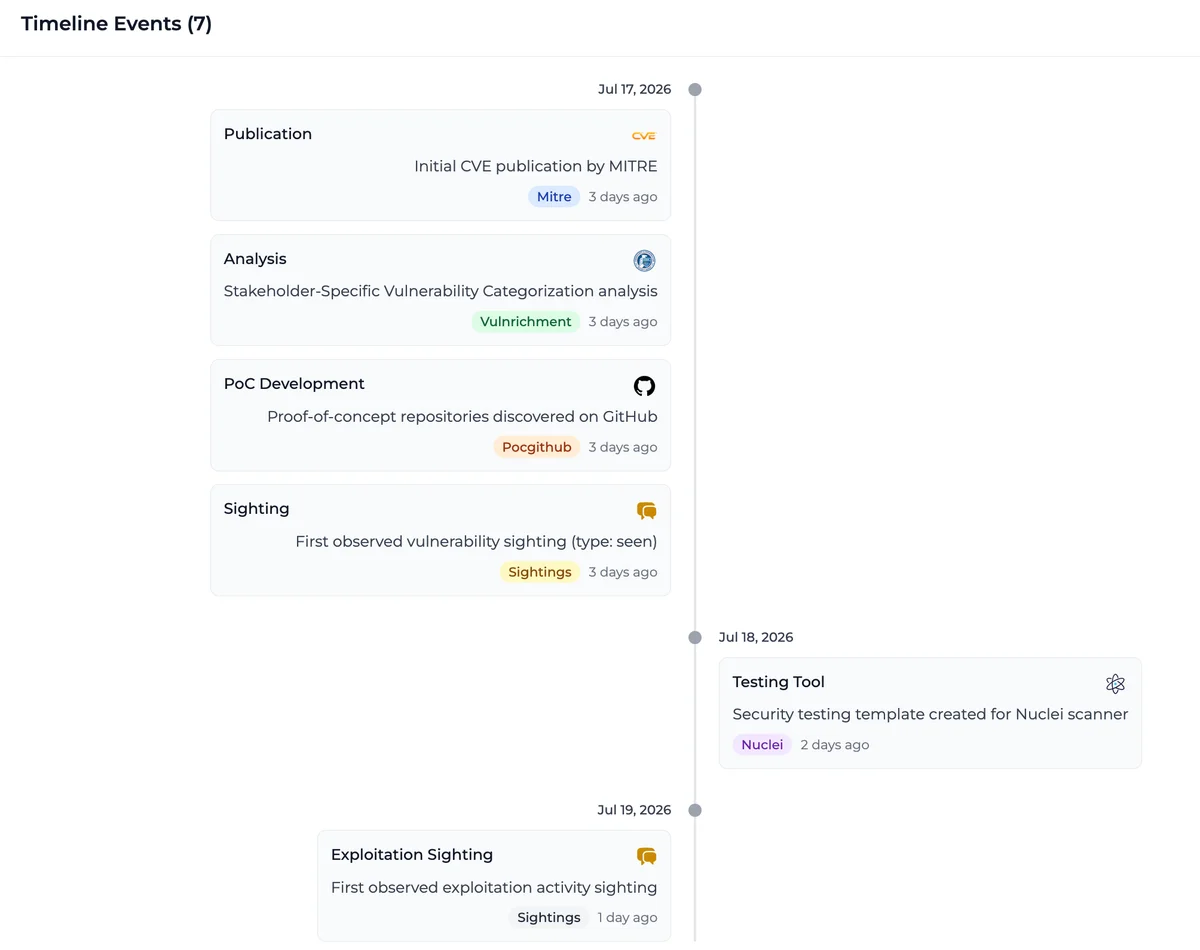
More striking still: a vulnerability with a low CVSS score (because exploiting it requires prior access, for example) can easily slip past conventional filters focused solely on "Critical". Yet it can be exploited at scale across the internet when chained with another flaw. That is exactly what we are seeing with the recent WordPress vulnerabilities (CVE-2026-63030 & CVE-2026-60137), combined into an exploitation chain named WP2Shell.
Facing AI: the inevitable explosion in volume
CVE volume is exploding. Witness the recent Microsoft Patch Tuesday (July 2026), which crossed the symbolic threshold of 500 vulnerabilities fixed. The arrival of AI models specialized in flaw discovery, such as Mythos, radically changes the scale of the problem by automating vulnerability research at a speed no human team can match.
Scanner knowledge bases are going to grow exponentially, and your reports will mechanically surface more and more flaws. If 200 critical CVEs per cycle is already unmanageable today, what happens when that number is multiplied by five or by ten?
Without a model to sort through that flow and strip out the noise, knowing more gains you nothing... You just drown faster.
Back to basics: focus on real risk
Let us go back to fundamentals: at SYRN, we are convinced the key is not to detect more, but to prioritize effectively.
Prioritizing means calculating a risk level by combining impact and likelihood of occurrence. CVSS gives you the theoretical technical impact, but it stays blind to the likelihood that an attacker actually exploits that flaw against you.
We built the SYRN Score to fill that gap. We automatically aggregate more than 20 Threat Intelligence sources in real time to sharpen that likelihood of occurrence:
- Has the CVE been added to CISA's KEV catalog?
- Is there a ready-to-use Metasploit module or Nuclei template?
- How many PoCs are published on GitHub, and how popular are they?
- Can this flaw be chained with another one?
We believe each of these signals is a concrete indication of imminent or active exploitation. Cross-referenced with one another, they turn a theoretical statistic into an operational priority.
What SYRN brings day to day
Through its API or its Portal, SYRN instantly enriches the results of your vulnerability scanner. It applies the SYRN Score to every CVE identified to give you its real likelihood of occurrence.
The scan answers the question: "What?"
SYRN answers the question: "What do I handle first, and why?"
The more CVE volume grows, the more this sorting layer becomes indispensable to absorb the load without burning out your teams.
Two complementary tools, not competitors
The scan produces a bulky action plan; SYRN makes it actionable.
A good scanner tells you what exists. SYRN tells you what matters. That complementarity is what turns a plain list of vulnerabilities into a genuine remediation strategy.
And what if I told you that SYRN can now automatically pull in your scan reports and generate a prioritized, actionable list in a matter of seconds?
👉 Want to see how SYRN prioritizes your scan results?